
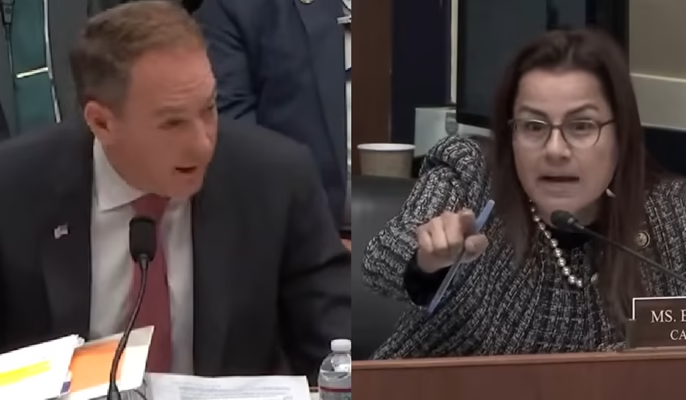
EPA Administrator Lee Zeldin (left) as Rep. Barragan rips him a new one.
By Rick Thomas, Columnist
“Now recognize the Gentlelady from California, Ms. Barragán.”
That was the introduction inside a Congressional hearing in Washington, D.C.
The “Gentlelady” was Congresswoman Nanette Barragán — the representative for California’s 44th Congressional District, which includes my neighborhood in Harbor Gateway South.
The witness sitting before Congress was EPA Administrator Lee Zeldin.
And finally — after years of residents being ignored, dismissed, and treated like collateral damage — Harbor Gateway South was no longer invisible.
Because one of the issues raised during that hearing came directly from this community.
Directly from the neighborhood surrounding Jones Chemicals, Inc.
At this point, I’m tired of even typing the company’s name. I hoped this story would already be over. Instead, families in Harbor Gateway South are still living next to a facility with a documented history of hazardous violations, while politicians, agencies, and institutions spent years looking the other way.
This is people’s lives.
This is a working-class community where residents raise children, walk their dogs as I do every day, attend school events, and try to live in peace — while wondering what exactly is being released into the air around them.
Congresswoman Barragán knows this neighborhood personally. She grew up here. She attended school here. She still lives here when she’s not in Washington.
And now the issue sitting in the middle of Harbor Gateway South has reached the United States Congress.
That matters.
Because for years, too many people acted like this community didn’t matter enough to protect.
“Now recognize the Gentlelady from California, Ms. Barragán.”
Good.
Because somebody finally did.
Jones Chemicals, Inc. has operated for decades in the middle of a residential community while government oversight repeatedly failed the people living around it. According to current public records, the Los Angeles Fire Department documented 48 fire code violations at the facility.
Forty-eight.
Not four.
Not eight.
Forty-eight.
And somehow the people demanding accountability are still treated like the problem.
That’s backwards.
Residents of Harbor Gateway South are not extremists because they want clean air, safe streets, and basic accountability from a chemical facility operating next to homes, schools, and the Cheryl Green Boys & Girls Club.
That is not unreasonable.
That is the bare minimum any community deserves.
During the hearing, Congresswoman Barragán questioned EPA Administrator Lee Zeldin directly:
“…in my district the EPA’s risk management program inspected a chlorine transfer facility… JCI Jones Chemicals… in 2015 and in 2017 and they found serious safety problems, including corroded equipment handling hazardous chemicals.”
Then came the part that should alarm everybody:
“When the EPA returned in 2024 it found many of the same issues again.”
Again.
That single word says everything.
Because communities like Harbor Gateway South are too often expected to simply absorb risk, stay quiet, and be grateful for whatever scraps of accountability eventually arrive years later.
Meanwhile, residents are told to “engage in dialogue” with corporations that continue operating despite repeated violations and ongoing public concern.
Dialogue matters.
But accountability matters more.
And the people living here are exhausted.
They are exhausted from being talked down to.
Exhausted from watching agencies protect relationships instead of neighborhoods.
Exhausted from hearing carefully worded public relations statements while families live with real fear.
This is not a game to the people living here in Harbor Gateway South.
Residents should not have to keep “shelter in place” kits inside their homes just because they live near an industrial facility.
That should disturb everybody.
Congresswoman Barragán also pointed out that repeated violations were not treated as repeat offenses because inspections occurred years apart and penalties remained minimal.
A few thousand dollars.
That’s apparently the price tag attached to years of hazardous conditions inside a working-class Los Angeles neighborhood.
And people wonder why residents are angry.
Los Angeles City Councilmember Tim McOsker has now called for stronger oversight and enforcement involving the facility, writing that constituents have demanded clarity regarding safety and enforcement authority.
Truthfully, the residents already have clarity.
The clarity came from 48 fire code violations.
The clarity came from repeated inspections identifying ongoing problems.
The clarity came from years of residents feeling unheard while institutions protected process over people.
What Harbor Gateway South needs now is no more excuses.
It needs enforcement.
It needs transparency.
It needs leadership willing to prioritize residents over corporate comfort.
And to be fair, leadership is finally beginning to emerge.
Congresswoman Barragán and Councilmember McOsker previously worked together to address truck idling in Harbor Gateway South, another quality-of-life issue that residents were forced to endure for years.
That effort made a visible difference.
People noticed.
The trucks stopped idling.
The neighborhood got quieter.
Residents felt heard.
We did.
I did.
That matters because Harbor Gateway South is not asking for luxury.
People here are asking for dignity.
For safety.
For basic respect.
There is still a long fight ahead. Jones Chemicals, Inc. has already responded aggressively through legal channels, and nobody should pretend this issue disappears overnight.
But for the first time in a long time, residents can see elected officials publicly confronting the issue instead of avoiding it.
That changes things.
Because Harbor Gateway South deserves the same protection, urgency, and respect as any other community in Los Angeles.
No family should feel abandoned simply because they live next to industry.
And no resident should be attacked for refusing to stay silent about it.